Sleeper juror
The Brass VerdictThe sleeper juror is the covertly planted juror at the center of the conspiracy surrounding Walter Elliot’s murder trial. More than a vote secured in advance, the scheme depended on placing a persuasive operator inside the jury, where that person could influence deliberations from within. Its discovery changes the trial from a contest over circumstantial evidence into a crisis over whether the jury itself has been secretly compromised.
Purpose and Stakes
The plan arose against the prosecution’s case that Elliot had motive and opportunity to kill his wife and her lover. The state relied on the affair, a prenuptial agreement, and the timing of Elliot’s car leaving Archway; Mickey Haller assessed the remaining evidence as thin and circumstantial. In his opening statement, he presented the prosecution’s account as a complicated construction of smoke and mirrors and promised to expose reasonable doubt. The sleeper offered Elliot an additional safeguard: even if the defense did not persuade the jury as a whole, one planted juror could disrupt the path to conviction.
Elliot described the intended juror as more than a passive holdout. He expected the person to speak forcefully for the defense during deliberations, turn other jurors, and press for acquittal. If an acquittal could not be secured, the sleeper would at least resist conviction and leave the jury hung, forcing the case to begin again. Elliot said he had been told that juror seven would be on his side, but claimed not to know who the person was. The plan therefore relied on influence exercised inside the jury room, not simply on a guaranteed vote announced in advance.
The Offer and Its Timing
Elliot said his corporate attorney connected him with Jerry Vincent, who first handled the defense fee arrangement. At least five months before the trial, Vincent told Elliot that an unknown party had offered to place a favorable person on the jury. The offer came with a condition: the trial had to remain on its scheduled date, because the planted juror could not be transferred to a different jury if the case were postponed. Elliot and Vincent accepted. Elliot said that he feared conviction despite maintaining that he had not killed his wife and believed the odds were against him.
The timing requirement made the scheme dependent on controlling more than the final panel. Mickey Haller reasoned that jury selection involved several successive random processes: the weekly pool of people summoned for jury duty, the venire selected for a particular trial, and the computer-generated order in which prospective jurors were called into the box. If the sleeper had to appear in one particular trial, the unknown party must have had access to each stage. Haller further reasoned that the defense would know not to remove the sleeper, while the juror could avoid a prosecution challenge by appearing to favor the state. These were Haller’s deductions about how the operation could work, rather than details Elliot said he personally knew.
The money trail raised questions about Vincent’s role but did not, by itself, establish a payment to the unknown party. Vincent’s firm had $38,000 in its operating account and $129,000 in its trust account; the trust balance included a $100,000 check from Elliot deposited on the Friday before Haller reviewed the accounts with Lorna Taylor. Separately, Harry Bosch told Haller that Vincent had accumulated $100,000 in a personal investment account five months earlier and instructed his broker to cash it out a week later. The timing gives the financial detail significance alongside Elliot’s account of an offer made about five months before trial, but the available information does not trace that money to the jury scheme.
The Plan Meets the Defense
The fixed trial date became important when Vincent later changed course. Elliot said Vincent told him on the Monday before the relevant events that the defense no longer needed the fix: Vincent believed he had found a strong evidentiary answer, a magic bullet, and intended to seek a delay. Elliot inferred that abandoning the arrangement might have led to Vincent’s death, saying he thought the people behind it would not let them withdraw. His inference gives the change of plan a possible connection to Vincent’s killing, but Elliot did not claim to know who ordered it or how it happened.
The defense’s new evidence concerned gunshot residue. At trial, Shamiram Arslanian explained that Elliot had been placed in the back of the four-alpha patrol car, where residue from another case could transfer to his hands, arms, and clothing. She described a second transfer from his hands and arms to the front of his jacket during ordinary movement. That explanation supplied the evidentiary alternative Vincent believed could make the sleeper unnecessary. The contrast is central to the scheme: the planted juror was commissioned when Elliot feared the state’s case, yet the defense later developed a way to challenge a physical piece of that case without relying on a corrupt deliberation.
Exposure of Juror Seven
At dinner, Haller connected Elliot’s insistence that the trial could not be delayed with the planted-juror arrangement. He identified juror seven as the expected sleeper. Elliot confirmed that the defense had been told the seat would be theirs and described its occupant as a persuader, but said he did not know the person’s identity. The exchange turned a vague suspicion about bribery into an account of the intended function of a particular seat in the jury box.
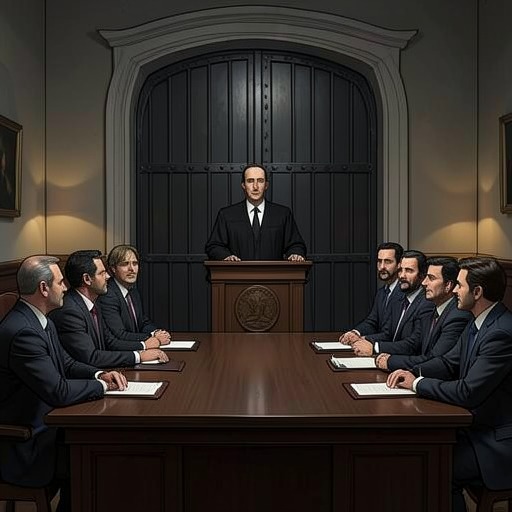
The later investigation revealed that the man sitting in seat seven was not the person officially assigned to it. Judge Stanton said the court’s computer listed Rodney L. Banglund, a Lockheed engineer from Palos Verdes, but the person who had occupied the seat for two weeks was someone else. The real Banglund reportedly knew nothing of the summons and said he had never received one; the unidentified occupant was missing. The discovery exposed an identity substitution, not merely a juror with undisclosed preferences. It also left the sleeper’s actual identity and whereabouts unresolved in the information available at that point.
The court’s response followed a letter addressed personally to Judge Stanton, which he said his office received on Thursday and which he opened after court on Friday. He then informed Haller and prosecutor Jeffrey Golantz that there was an unusual, developing matter involving juror misconduct. The letter initiated the disclosure of a problem; the supplied account does not establish that it named the impostor or explained the full scheme.
Ethical and Institutional Consequences
Elliot’s account placed Haller in a conflict between his duty to keep client communications confidential and the prospect of future jury tampering. Haller reasoned that the payment or offer already made was a past crime, while the intended interference with deliberations would not occur until the jury began deliberating. He believed the planned crime triggered a duty to report it, while also recognizing that he might avoid reporting if he could stop the tampering from happening. The sleeper therefore implicated not only the integrity of the verdict but the limits of a defense lawyer’s obligations when a client reveals a continuing criminal plan.
The subsequent grand-jury indictments widened the matter beyond an isolated attempt to influence one trial. Harry Bosch told Haller that indictments had been returned against Judge Holder, Mitch Lester, Bruce Carlin, David McSweeney, and a supervisor in the jury office who had given them access to the computers. The group was to be arrested simultaneously. Those indictments connect the jury-seat deception to access within the court’s selection machinery, although indictments alone do not establish the defendants’ guilt.
As a concept, the sleeper juror joins two forms of persuasion that a fair trial is supposed to keep separate. Haller’s public defense invited jurors to interpret evidence and find reasonable doubt; the secret plan sought to predetermine the force and direction of deliberation by manipulating who entered the jury box. The impostor discovery makes that distinction concrete: the threat was not only that one juror might argue strongly for acquittal, but that the selection process itself could be corrupted before the jurors heard the case.